Author: Serge Fortin

  • ERDN 2026

    ERDN 2026

    Beyond Infrastructure: Reflections from ERDN 2026

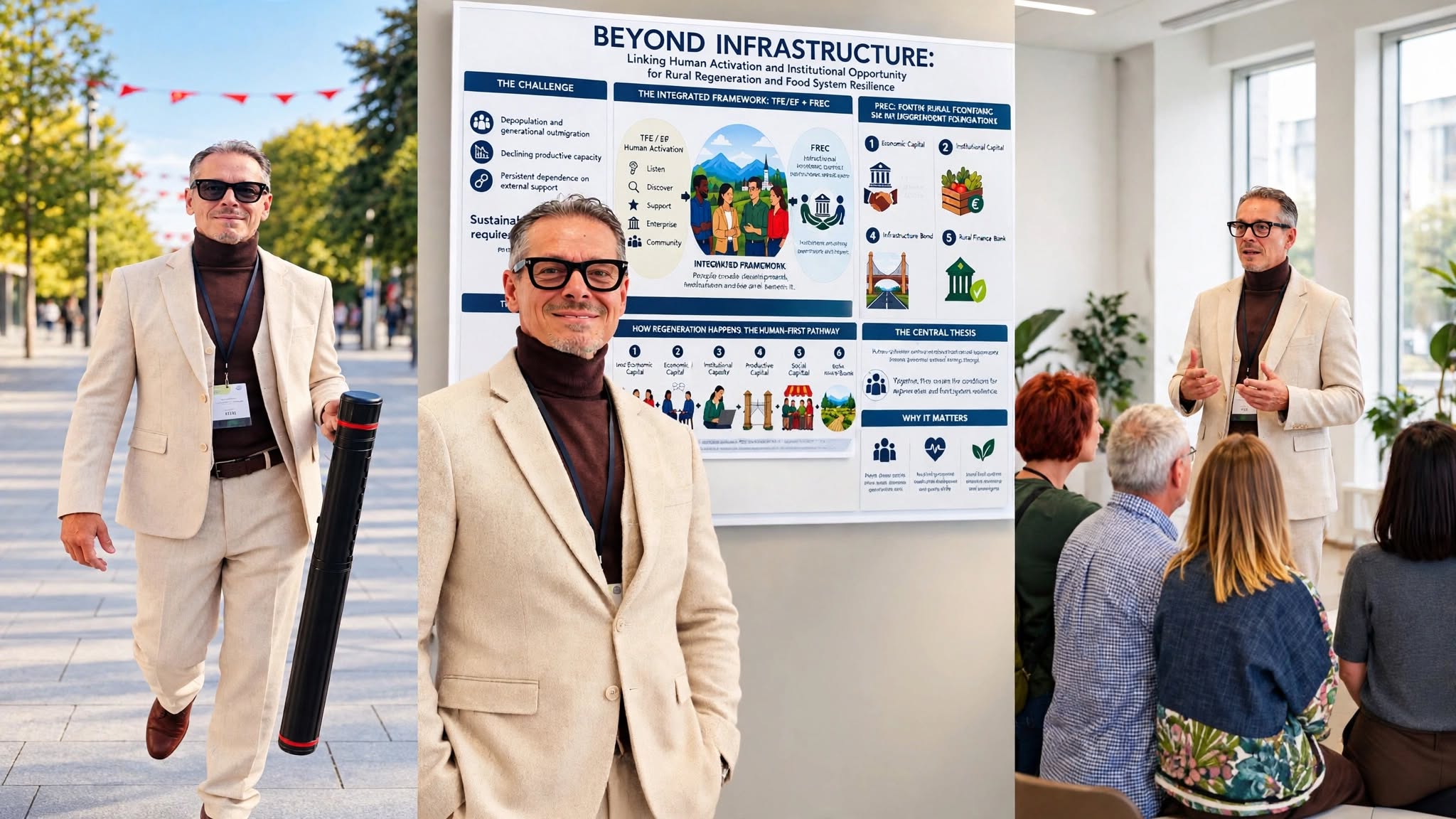
    From 29 September to 1 October 2026, I attended the XXII European Rural Development Network Conference in Mitrovica, Kosovo. After months of research, writing and preparation, it was an opportunity to bring our work into a wider conversation about the future of rural communities.

    The question at the heart of my contribution was straightforward:

    How do we move from managing rural decline to creating lasting rural regeneration?

    Connecting People and Opportunity

    At the conference, I presented work developed with Dr. Ernesto Sirolli, bringing together two complementary approaches.

    Enterprise Facilitation focuses on discovering and supporting the entrepreneurial capacity already present within communities: people’s ideas, skills, ambitions and willingness to build something.

    **FREC—the Fortin Rural Economy Compact—**focuses on the institutional conditions needed to help that potential take root, grow and become economically sustainable.

    Our contribution, Beyond Infrastructure: Linking Human Activation and Institutional Opportunity for Rural Regeneration and Food System Resilience, explores how these approaches might work together.

    The proposition is simple: capable people can remain blocked when the conditions around them offer little opportunity. Equally, investment in infrastructure and institutions can leave opportunities unused when people lack the support to pursue them.

    Connecting these two dimensions is the starting point of our work.

    From a Proposition to a Testable Framework

    The next question is whether combining these approaches can produce stronger, measurable and durable rural regeneration.

    That remains a question to investigate. Presenting a framework is one step; understanding how it performs in real communities requires careful testing, clear responsibilities and a willingness to revise assumptions.

    Any future pilot should begin with local priorities. What are residents trying to achieve? What prevents viable enterprises from developing? Which institutional arrangements help, and which create unnecessary obstacles?

    Evaluation should examine both the intended benefits and the difficulties: what changes, who benefits, what it costs, and what fails to work as expected.

    The aim is to test, challenge, measure and improve the framework.

    An Invitation to Collaborate

    Following ERDN 2026, I welcome contact from researchers, universities, municipalities, development organisations and rural communities interested in examining this approach.

    Possible collaboration could include reviewing the framework, identifying suitable research settings, defining evaluation methods or exploring the conditions for a future pilot.

    I am particularly interested in perspectives grounded in the daily experience of rural life. Research needs to remain connected to the people whose livelihoods, businesses and communities it seeks to understand.

    The conference has ended, but the questions remain open—and the conversation can continue.

    If your work connects with rural development, entrepreneurship, food systems, Enterprise Facilitation or FREC, I would be pleased to hear from you.

    ERDN

    The European Rural Development Network (ERDN) dates back to 2002. It was established to integrate the efforts and competences of various European research institutions in their joint works on the state and paths of transformation of rural areas, in particular farming, with the view to extension of the EU and its future policies.

  • What Makes a Rural Community Resilient?

    What Makes a Rural Community Resilient?

    What Makes a Rural Community Resilient?

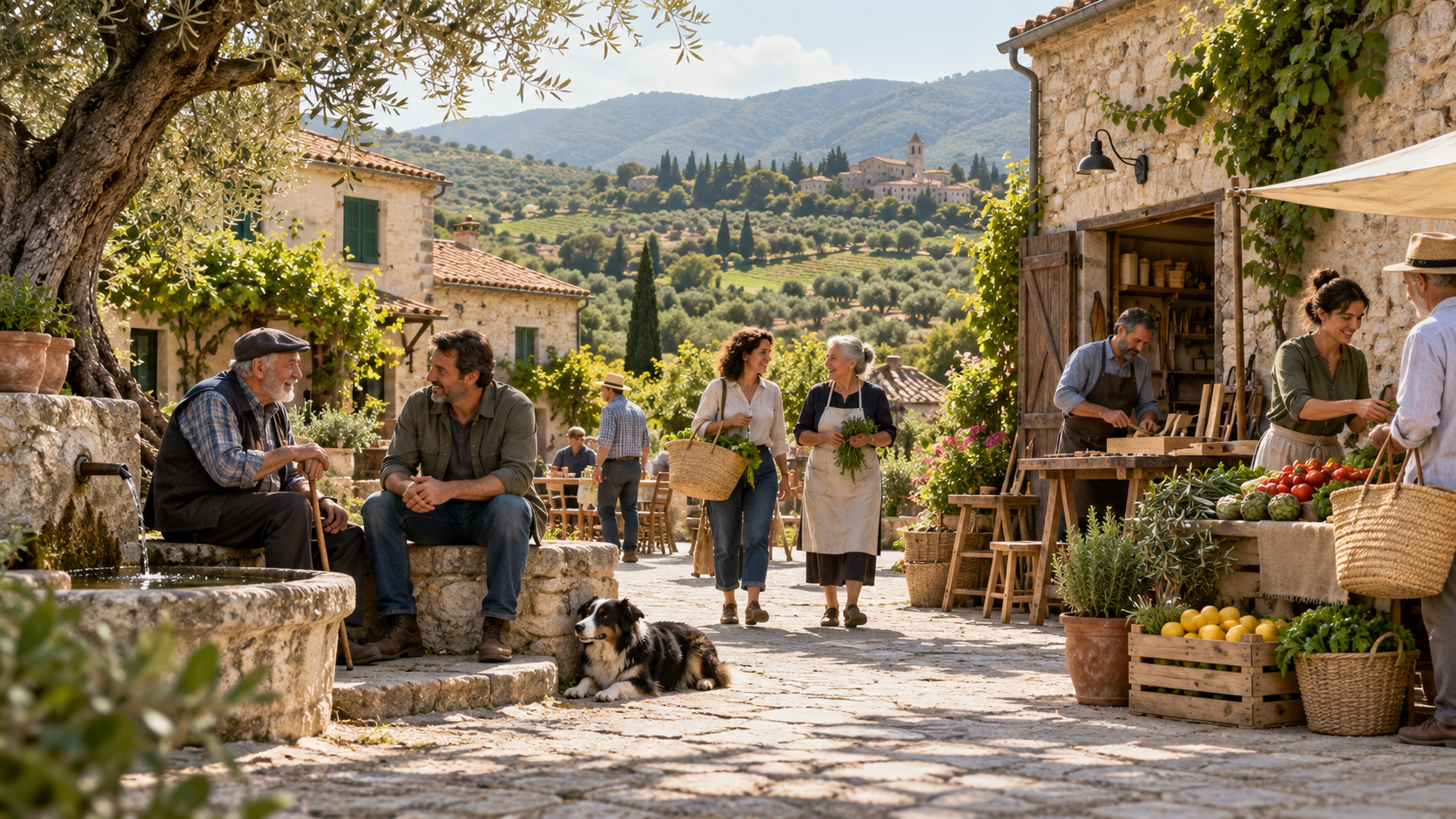
    When I think about rural resilience, I begin with everyday questions. Can people find meaningful work near their homes? Can a young family afford to stay? Can someone turn a useful skill into a viable local business?

    These questions shape my work on the Fortin Rural Economy Compact, or FREC. I am developing it as a framework for examining the relationships between local production, housing, infrastructure, finance, and community participation. Its proposals require scrutiny, practical testing, and adaptation to local circumstances.

    Looking at the connections

    Consider a hypothetical village that wants to attract new businesses. A workshop might need reliable electricity, suitable premises, financing, and customers. Its employees might also need housing, transport, and childcare.

    For me, this raises a question about how development decisions are made. If each issue is considered separately, what might be overlooked between them? Could a coordinated approach make the conditions for local enterprise easier to understand and address?

    This is a starting point for investigation. It does not establish that any particular framework will succeed. That requires evidence from implementation, including an honest account of costs and unintended consequences.

    Listening before designing

    I want local knowledge to help define the problem before a solution is proposed. Residents, business owners, farmers, and public service workers may describe different obstacles within the same place. Those differences deserve attention.

    A credible discussion should also ask who benefits, who carries the financial risk, and who has a voice in decisions. An attractive proposal on paper still needs workable responsibilities, transparent governance, and a realistic maintenance plan.

    What would count as progress?

    Any future evaluation of FREC should define success before implementation begins. Possible measures could include business survival, housing affordability relative to local incomes, access to essential services, and the distribution of benefits. These are proposed areas for assessment, not results already demonstrated by the framework.

    I also want to understand where an approach fails. Which assumptions prove unrealistic? Which arrangements require too much administration? What would residents choose to change?

    An invitation to contribute

    FREC remains a developing framework, open to examination and constructive criticism. I welcome perspectives from researchers, practitioners, entrepreneurs, and people whose knowledge comes from living and working in rural communities.

    If you could address one obstacle to a viable future in your community, where would you begin, and why?

  • Reading Beyond Agreement

    Reading Beyond Agreement

    Reading Beyond Agreement

    I do not expect every worthwhile book to confirm what I already believe. Sometimes a passage stays with me because I resist it. That resistance can become the beginning of a useful conversation.

    As a reader and writer, I am interested in what happens between understanding an argument and accepting it. We can examine an idea carefully without endorsing it. We can also admire a book while questioning some of its conclusions.

    Pause before answering

    When a passage provokes a strong response, I try to identify the precise claim being made. Is the author describing an experience, interpreting evidence, expressing a preference, or proposing a general rule? Those different kinds of statements need different kinds of responses.

    I then ask whether I could explain the argument fairly to someone who has not read it. Have I understood its strongest version? Am I responding to the words on the page, or to an assumption I have brought to them?

    Understanding a position does not settle whether it is sound. It gives us something clearer to examine. We can then ask what supports it, what challenges it, and where uncertainty remains.

    Make the discussion specific

    A useful book discussion can begin with a single passage. One reader may notice an assumption that another overlooks. Someone else may connect the same words to a different experience.

    I would like discussions here to make room for those differences. Participants should be able to question an argument directly while treating one another respectfully. Nobody should need to agree with the author, or with me, to contribute.

    Changing our minds is one possible outcome. Finding a more precise reason for disagreement is another. Sometimes the most useful result is discovering a question worth pursuing in another book.

    The Book Club I want to build

    This is the spirit I want to bring to the Book Club planned for this website. I envisage shared reading, thoughtful questions, and scheduled conversations where curiosity matters more than winning an argument. Details about the first book and meetings will be announced once they are confirmed.

    For now, the conversation can begin beneath this article. You do not need a formal review or an academic background. A specific passage and an honest question are enough.

    Which book challenged an assumption you held, and what did you do with that challenge?

  • Concept illustration of the Fortin Flower.

    Concept illustration of the Fortin Flower.

    The Fortin Flower: Questions Before a Prototype

    The Fortin Flower begins with an exploration of form and function. Could a structure inspired by a plant provide a useful way to arrange environmental technologies? What would have to be demonstrated before that idea deserved practical development?

    The concept imagery includes photovoltaic leaves with integrated ducted turbines, supported by articulated arms. These illustrations communicate a proposed design direction. They do not establish energy output, structural reliability, economic viability, or environmental performance.

    Why share an unfinished concept?

    I am sharing the Fortin Flower to invite informed examination while the design remains open to revision. Engineers and researchers may identify constraints that change its form substantially. Such changes would be part of developing the idea responsibly.

    A useful response could support one element while challenging another. It could also show that a simpler arrangement would perform better. The purpose of evaluation is to discover which parts, if any, deserve further work.

    The questions that matter

    The first questions concern the proposed combination of technologies. How would the position of each leaf affect solar exposure and airflow? Would the turbine arrangement produce useful energy under realistic conditions? Could one component interfere with another?

    The structure introduces another set of questions. How would articulated arms respond to repeated movement and changing wind loads? What materials and connections would be appropriate? How would technicians inspect, repair, or replace components safely?

    An assessment would also need to consider noise, weather exposure, installation requirements, and effects on the surrounding environment. Each issue calls for a defined method of evaluation. A visual resemblance to nature cannot answer those questions.

    Comparison belongs in the process

    Any future prototype should be assessed against relevant conventional alternatives under comparable conditions. That comparison should include energy output, installation cost, maintenance demands, and expected service life. The project would need to explain what practical advantage justified its additional complexity.

    At this stage, I am not presenting verified performance figures or a commercially available product. The Fortin Flower is a concept seeking technical evaluation and collaboration. Its next steps should be guided by what can be measured and tested.

    An invitation to examine the idea

    I welcome contributions from people with experience in renewable energy, structural design, materials, controls, environmental assessment, and maintenance. Constructive criticism is particularly valuable when it identifies a specific assumption and a way to test it.

    Which question would you investigate first before committing resources to a prototype?

  • Why Independent Research Needs Room to Wander

    Why Independent Research Needs Room to Wander

    Curiosity Before Conclusions

    Independent research begins with a simple discipline: staying with a question long enough for it to become more interesting. Away from the pressure to produce quick answers, a researcher can follow connections between landscapes, communities, systems, and ideas that may otherwise remain separate.

    For Serge Fortin, writing and research are complementary practices. One makes space for careful observation; the other gives those observations a form that readers can question, revisit, and carry into their own work.

    Thinking Across Boundaries

    Some of the most useful questions do not fit neatly inside a single field. How might rural economies become more resilient? What can environmental infrastructure learn from natural patterns? Where do practical design, local knowledge, and long-term stewardship meet?

    These questions call for an out-of-the-box approach, but not for speculation without care. They ask for reading widely, testing assumptions, listening closely, and being clear about what is known, what is still developing, and what deserves further exploration.

    Good research does not close a conversation too soon. It gives better questions somewhere to grow.

    Ideas in Development

    This site brings together books, original research, and developing concepts, including the Fortin Rural Economy Compact and the Fortin Flower. Each area is presented as an invitation to explore: some materials will be complete, while others will remain clearly marked as works in progress.

    • Books offer space for sustained reflection and new perspectives.
    • Research examines questions that benefit from patient, independent inquiry.
    • Projects open a path for dialogue with readers, practitioners, engineers, and potential collaborators.

    Join the Conversation

    Meaningful work improves through thoughtful exchange. If an idea here connects with your reading, research, practice, or project, you are welcome to continue the conversation.

    Get in touch to collaborate or share a perspective.