Framework
A COMPACT FOR RURAL REGENERATION
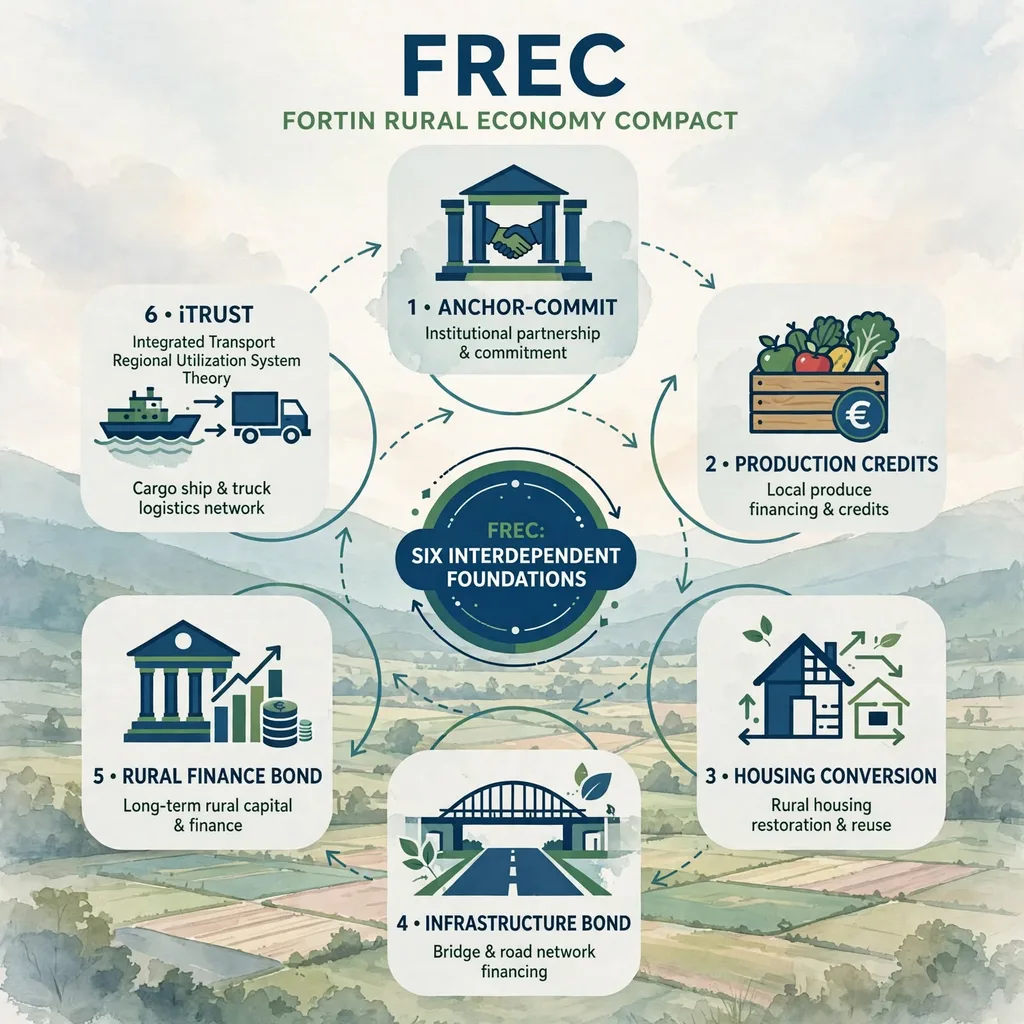
The Fortin Rural Economy Compact (FREC), developed by Serge Fortin, proposes six interconnected foundations for rural regeneration. These foundations address institutional commitment, productive activity, housing, infrastructure, finance and transport. They are designed to operate together as one coherent compact, with each foundation supporting and depending on the others.
Explore
SIX FOUNDATIONS. ONE COMPACT.
FREC proposes six interconnected foundations for rural regeneration. Each foundation supports and depends on the others.
Together, they form one compact designed to address institutional commitment, production, housing, infrastructure, finance and transport.
1. ANCHOR-COMMIT
Anchor-Commit proposes binding institutional commitments over several years. These commitments would give rural producers, entrepreneurs and investors a more dependable planning horizon. Transparent monitoring would hold participating institutions accountable.
2. PRODUCTION CREDITS
Production Credits would reward verified local production through fiscal benefits. They would cover agricultural output, manufactured goods, traded services and cooperative revenues. Documented production would also inform financing decisions and help match transport capacity to actual output.
3. HOUSING CONVERSION
Housing Conversion would bring underused rural buildings into residential and productive use. Support would prioritise housing for local workers and entrepreneurs, with safeguards against speculation and holiday accommodation. This foundation connects housing availability with the workforce needed to sustain rural economic activity.
4. INFRASTRUCTURE BOND
The Infrastructure Bond would turn infrastructure commitments into enforceable civic contracts. These contracts would specify delivery deadlines, performance requirements and consequences for failure to deliver. This foundation would give communities and businesses greater certainty about the infrastructure supporting their activities.
5. RURAL FINANCE BOND
The Rural Finance Bond proposes a dedicated, publicly guaranteed capital instrument for rural development. It would provide funding continuity beyond annual budgets and changing political priorities. This foundation would support investment alongside the compact’s commitments to production, housing, infrastructure and transport.
6. ITRUST
iTRUST stands for Integrated Transport Regional Utilization System Theory. It proposes coordinating roads, underused railways, regional airports and shared container infrastructure through a rural transport logistics cooperative. Production Credits data would help match transport capacity to actual output, with governance progressing towards community operational independence.
HOW THE COMPACT WORKS AS A WHOLE
Institutional commitments provide a dependable planning horizon, while Production Credits make local economic activity visible. Housing supports the workforce, infrastructure enables operations, and finance supports investment and continuity. Transport connects rural production to customers and markets.
These foundations are designed to reinforce one another. Access to finance cannot compensate for missing transport, just as production opportunities cannot compensate for unavailable worker housing. FREC therefore proposes all six foundations as one integrated compact, whose feasibility and combined effects require independent evaluation and practical testing.
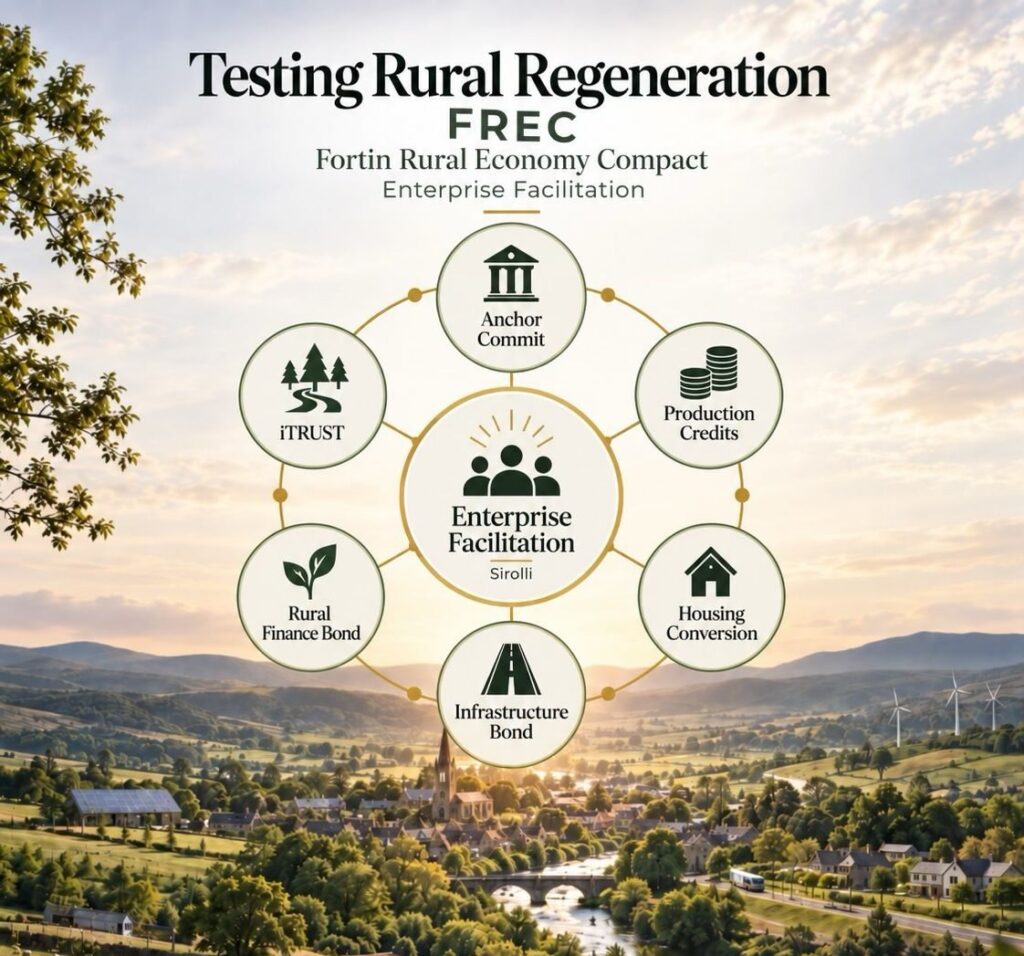
FREC AND ENTERPRISE FACILITATION: A POTENTIAL JOINT FRAMEWORK
Enterprise Facilitation (EF), developed by Dr. Ernesto Sirolli, focuses on supporting people who wish to develop entrepreneurial ideas. FREC, developed by Serge Fortin, proposes the institutional conditions that could help those initiatives take root and grow.
Their potential combination connects human initiative with institutional opportunity.
Joint work by Serge Fortin and Dr. Ernesto Sirolli was presented as a poster at the 2026 European Rural Development Network (ERDN) conference in Mitrovica, Kosovo. Entitled “Beyond Infrastructure: Linking Human Activation and Institutional Opportunity for Rural Regeneration and Food System Resilience,” it explores how entrepreneurial support and coordinated institutional commitments could reinforce each other.
Whether their combination produces stronger and more durable outcomes remains a question for independent research and practical testing.
Supporting documents
Collaboration
Help TEST FREC
Interested in research discussion, practitioner insight, or collaborative exploration? Get in touch with Serge Fortin.