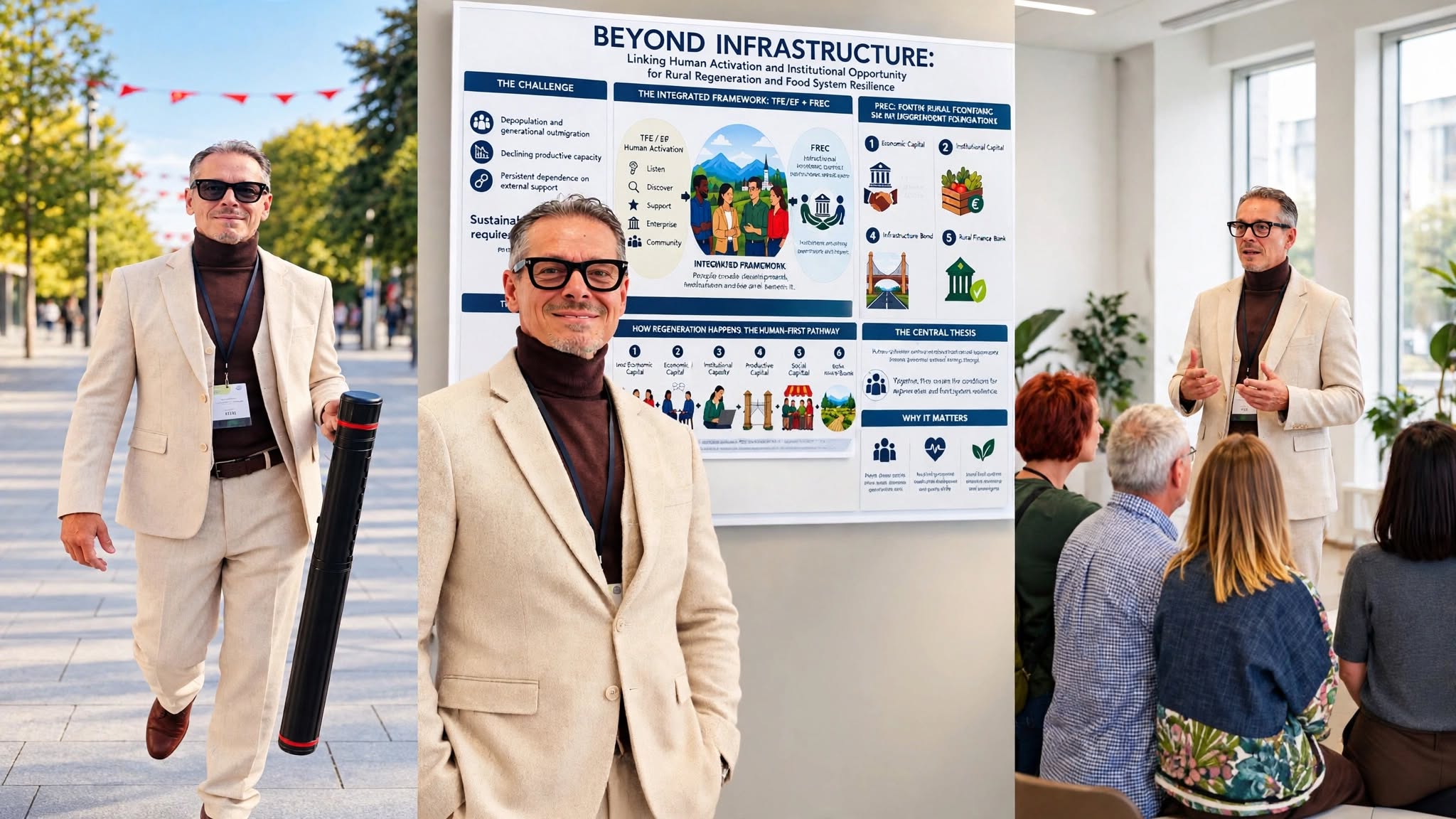
Beyond Infrastructure: Reflections from ERDN 2026
From 29 September to 1 October 2026, I attended the XXII European Rural Development Network Conference in Mitrovica, Kosovo. After months of research, writing and preparation, it was an opportunity to bring our work into a wider conversation about the future of rural communities.
The question at the heart of my contribution was straightforward:
How do we move from managing rural decline to creating lasting rural regeneration?
Connecting People and Opportunity
At the conference, I presented work developed with Dr. Ernesto Sirolli, bringing together two complementary approaches.
Enterprise Facilitation focuses on discovering and supporting the entrepreneurial capacity already present within communities: people’s ideas, skills, ambitions and willingness to build something.
**FREC—the Fortin Rural Economy Compact—**focuses on the institutional conditions needed to help that potential take root, grow and become economically sustainable.
Our contribution, Beyond Infrastructure: Linking Human Activation and Institutional Opportunity for Rural Regeneration and Food System Resilience, explores how these approaches might work together.
The proposition is simple: capable people can remain blocked when the conditions around them offer little opportunity. Equally, investment in infrastructure and institutions can leave opportunities unused when people lack the support to pursue them.
Connecting these two dimensions is the starting point of our work.
From a Proposition to a Testable Framework
The next question is whether combining these approaches can produce stronger, measurable and durable rural regeneration.
That remains a question to investigate. Presenting a framework is one step; understanding how it performs in real communities requires careful testing, clear responsibilities and a willingness to revise assumptions.
Any future pilot should begin with local priorities. What are residents trying to achieve? What prevents viable enterprises from developing? Which institutional arrangements help, and which create unnecessary obstacles?
Evaluation should examine both the intended benefits and the difficulties: what changes, who benefits, what it costs, and what fails to work as expected.
The aim is to test, challenge, measure and improve the framework.
An Invitation to Collaborate
Following ERDN 2026, I welcome contact from researchers, universities, municipalities, development organisations and rural communities interested in examining this approach.
Possible collaboration could include reviewing the framework, identifying suitable research settings, defining evaluation methods or exploring the conditions for a future pilot.
I am particularly interested in perspectives grounded in the daily experience of rural life. Research needs to remain connected to the people whose livelihoods, businesses and communities it seeks to understand.
The conference has ended, but the questions remain open—and the conversation can continue.
If your work connects with rural development, entrepreneurship, food systems, Enterprise Facilitation or FREC, I would be pleased to hear from you.
ERDN
The European Rural Development Network (ERDN) dates back to 2002. It was established to integrate the efforts and competences of various European research institutions in their joint works on the state and paths of transformation of rural areas, in particular farming, with the view to extension of the EU and its future policies.